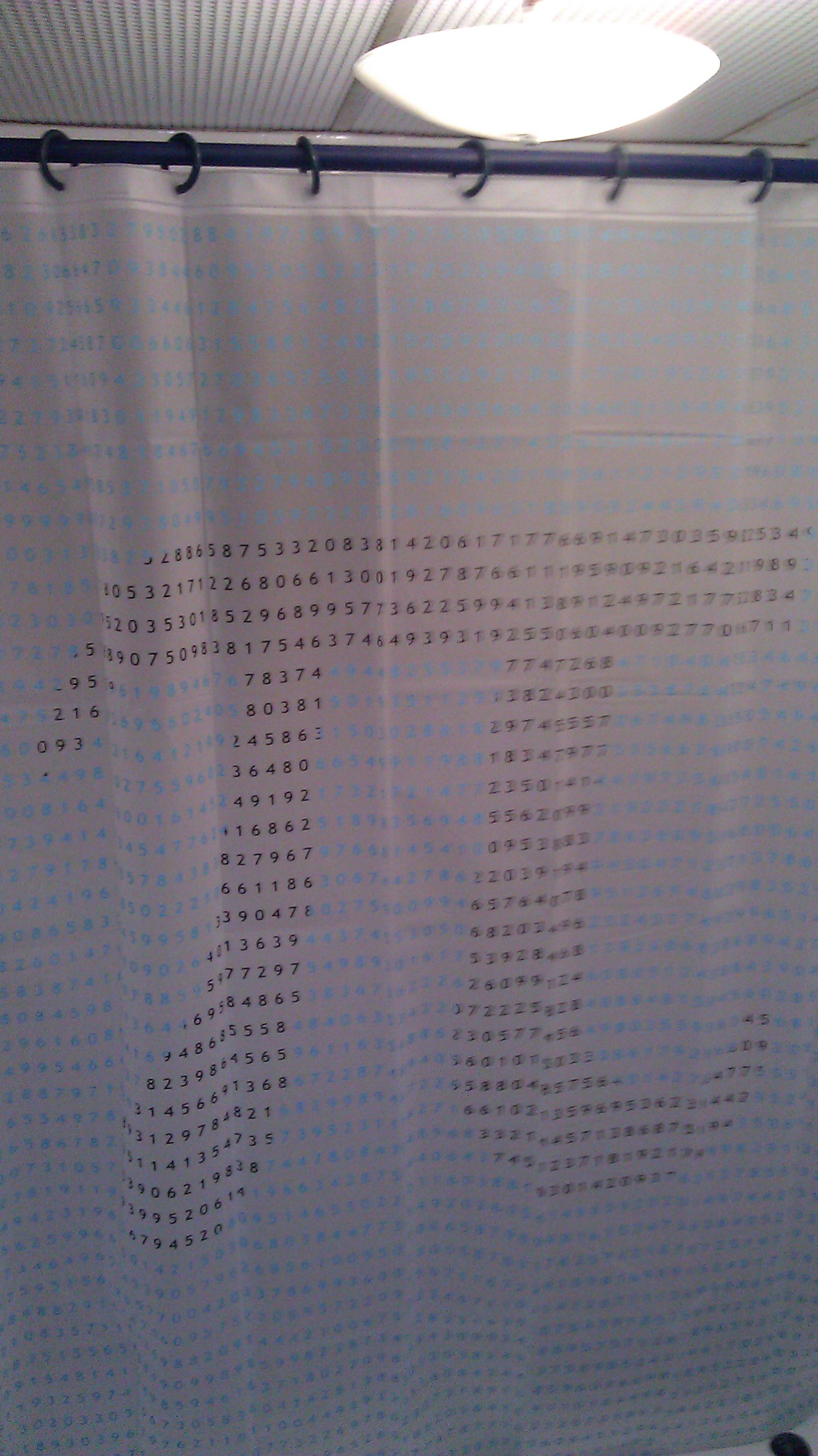
Can't let pi-day pass without mention...

I spent the evening doing a little redecorating to prepare. (Ah ... the things you can get away with as a bachelor ...).

Now what to do about those pesky tau protestors?

Walmart and feeding the poor

Here's an excerpt of what a piece entitled Walmart is no savior: More small businesses = healthier people had to say:

Those whose focus is on the health of our communities and on the pernicious effects of obesity and diabetes say that Walmart’s unmatched ability to provide affordable access to healthy foods like fruits and vegetables, especially in areas that currently lack them, outweighs the potential negative effects the FWW report describes.

But a recent study published in the Cambridge Journal of Regions, Economy and Society suggests that communities that invite Walmart in may be making a devil’s bargain. The study found strong evidence that communities that rely on big box retailers — and large corporate employers in general — are less healthy and have higher rates of obesity and diabetes than those that don’t.

I'm wondering if they're controlling for all factors though. It would seem likely that communities oriented towards big-box retailers are less walkable. Downsize a Walmart, make it the size of a smallish business, and integrate into a walkable community and I wonder if you'd avoid at least a large portion of the effects noted.

Random links

Kids born later in the year more likely to be diagnosed with ADHD: Study
The impact of the current school system I'd guess. (Note that you'll see similar effects for things like sports stars - although that's slanted towards the beginning of the year, at least where leagues and schools divvy up kids that way).
Why an MRI costs $1,080 in America and $280 in France
"There is a simple reason health care in the United States costs more than it does anywhere else: The prices are higher. ... Americans don’t see the doctor more often or stay longer in the hospital than residents of other countries. Quite the opposite, actually." Would be nice if the article delved a little more into things like wait times.
Carrollwood hydrant project delayed by lack of women on crews
Yay... quotas. Looks like at least $16,000 more and a minimum 3 month delay. (Strange how, if women are underpaid, that they need to now look at bidders other than the lowest to find a crew with them on it).
Making over the mall in rough economic times
"The efforts reflect a shift in how Americans want to shop today: rather than going to big, overwhelming malls, many prefer places where stores can be entered from the street, featuring restaurants, entertainment and other Main Street mainstays. Also, as commuters in urban areas shift to public transportation, the giant parking lots are no longer needed." - gets too cold here in the winter to make entering from the street into every store preferable. Would kinda suck with rain as well.

Truth claims versus moral claims

I ran across the following statement in an article yesterday:

... only 52 per cent disagreed with the statement that “If a woman wears provocative clothing, she’s putting herself at risk for rape.”

The whole statment seems to be category confusion - confusing whether or not a statement is true with whether or not an action is moral. To say that a statement is true does not mean that the action the statement describes is more.

At the moment I've not yet heard a single argument as to why the statement would be false, but there seem to be reasons as why to it seems pretty likely to be true (although I have difficulty thinking of any way that a study trying to directly verify this would ever make it past an ethics review board. Examine the published, peer-reviewed literature and what do you find on the effects of clothing? One example:

Clothing is often an important external cue used by others in impression formation and to project an image of self.

That particular example comes in reference to business attire, but you'll find a similar response when studies focus on women in sweaters versus swimsuits (which is probably the closest scholarly research on the impact of clothing):

In the first experimental test of self-objectification, we manipulated the state by asking participants to wear swimsuits or sweaters. When wearing a swimsuit most people are likely to assume a third-person perspective and to view their bodies as objects. As predicted, we found that women wearing swimsuits described themselves more in terms of their bodies, experienced greater body shame and self-related emotions, were more likely to exhibit restrained eating, and performed worse on a math test than women wearing sweaters.

Where's the counterargument that clothing has no impact on victimization? I'm not sure how large an effect to effect, but based on the above I'd be surprised if there wasn't some statistically significant impact of clothing in this regard.

(This also doesn't address the utter hypocrisy when it comes to things like "victim blaming". Why do men make up about 80% of homicide victims? Per one USA Today columnist, it's "behavior, not biology". No victim blaming there whatsoever of course... I also can't say that I've seen too many demands from feminist groups for gender quotas for hazardous jobs, currently performed primarily by men).

Pages

Subscribe to Rotundus.com RSS