Possible film fest choices....

It seems to be film fest season again soon, so I figured I'm mentioned a few of the movies that seem to me to be interesting. I might see all; I might see none.

311: In the Moment
Survival stories from Japan following the tsunami that also set off the problems at Fukushima. Non-embedable trailer here.

The Ambassador
A documentary based on someone pretending to be a diplomat in a fairly corrupt region in Africa.

A moi seule
What results when someone is kidnapped and locked in a basement for a few years and then released? How can they cope? Trailer here.

Off white lies
An Israeli film in which a 13 year old girl encounters her estranged father and they visit the northern parts of the country encountering bombing during an Israeli-Lebanese conflict and who knows what else along the way:

Random links

DNA’s ‘Junk’ Now Seen As Lever Controlling Health
"Scientists previously thought that only genes, small pieces of DNA that comprise about 1 percent of the genome, have a function. The new findings show that an underlying circuitry exists in which 80 percent of the DNA code within each human cell can contribute to disease. This may be why large studies targeting gene variants haven’t identified treatable causes for many complex maladies, the scientists said. The circuitry can be disrupted at several individual waypoints."
We never talk any more: The problem with text messaging
"Part of the appeal of texting in [some] situations is that it's less painful — but the pain is the point. "The complexity and messiness of human communication gets shortchanged," Turkle says. "Those things are what lead to better relationships."
Habitual texters may not only cheat their existing relationships, they can also limit their ability to form future ones since they don't get to practice the art of interpreting nonverbal visual cues." The story mentions that "Americans ages 18-29 send and receive an average of nearly 88 text messages per day, compared to 17 phone calls" - my phone doesn't get used all that often for that sort of thing - I treat it primarily as a data connection.
Stanford researchers' cooling glove 'better than steroids' – and helps solve physiological mystery, too
"The temperature-regulation research of Stanford biologists H. Craig Heller and Dennis Grahn has led to a device that rapidly cools body temperature, greatly improves exercise recovery, and could help explain why muscles get tired."
When Rapists Seek Joint Custody of the Children They Father Through Rape, Everyone Loses
"Though instances of rapists seeking or even obtaining joint custody are apparently pretty rare, only 19 states have laws restricting the parental rights of men who father children through rape — everywhere else, men are technically allowed to seek such rights, and even if they don't intend on actually being part of their child's life, rapists have been known use the threat of joint custody as a way to blackmail their victims into not filing criminal charges." (The same also applies to male rape victims - albeit there being forced to pay their rapists rather than losing partial custody).

Embassies in Jerusalem? Diplomatic missions in Mecca?

It's a little strange when the list of examples for something consists of Israel and Saudi Arabia, but that seems to be the case when looking at some of the issues surrounding where countries choose to situate their embassies and other diplomatic missions.

First, Jerusalem: The status of any land in Israel and particularly the status of Jerusalem seems bound to create controversy. Now you've got Obama stating that Democratic support for Jerusalem as the US-recognized capital of Israel. Governments worldwide have chosen NOT to situate embassies in Jerusalem - there are no embassies there (although a some countries maintain offices of some sort). Embassies remain in Tel Aviv on somewhat less controversial land. I'm still a little confused as to why this should be an important issue in the US presidential elections though.

Second, Saudi Arabia: One thing that Saudi Arabia enforces (alongside the rest of its restrictions on religious freedom) is the exclusion of non-Muslims from a geographical region encompassing Mecca and perhaps some of it's surroundings.
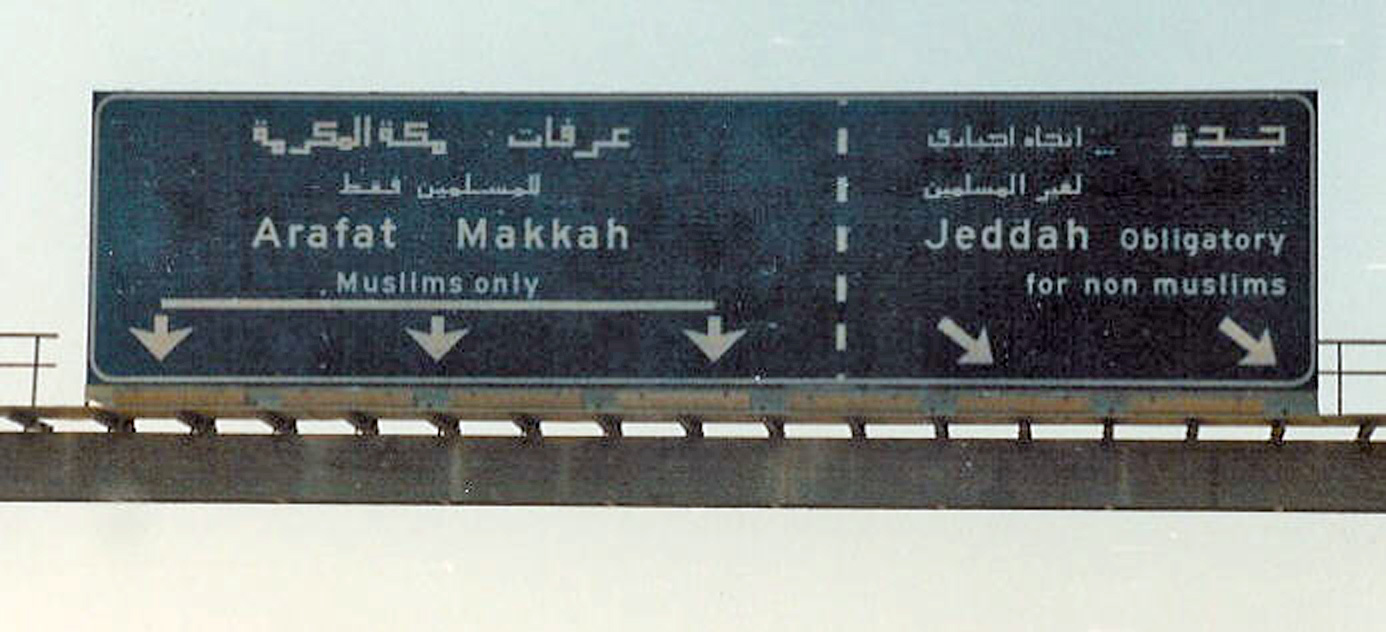
(Photo by Saicome - used under Creative Commons Attribution 2.5 Generic license)

Some have suggested that Canada should situate a diplomatic mission in Hajj, given that much of the foreign travel to the country is Hajj-related. Here a few comments that appeared in the media following a Canadian imam's encounter in that region with the religious police:

“The Canadian government did put pressure (on the Saudi government) but it took some time. They didn’t have anyone in place in those places,” [Islamic Human Rights Commission] chairman Massoud Shadjareh told Postmedia News.
... Shadjareh said the IHRC will call on the Canadian government to follow in the U.K.’s steps in providing support staff, such as a team of advisers and medics, to residents making the pilgrimage to Mecca. He said that if federal officials were present in Mecca and Medina, Sunday’s violent incident may not have occurred or it would have been resolved faster.
“It’s essential that the Canadian government offer its services to its citizens,” he said, noting that millions of people make the pilgrimage each year.
(Source: The National Post)

Given the Saudi government's position it would seem that any officials working in a diplomatic mission would be required to be Muslim, I'd have to say that I consider it a positive thing that Canada has no diplomatic mission there and no other country seems to have a diplomatic mission there either.

Lest you think that these restrictions might only apply to "normal" travel, French special forces that flushed out rebels who'd taken hostages in the Grand Mosque of Mecca back in 1979 were required to formally (and dubiously) convert to Islam to gain access to the area- I wonder if they gave much thought to Saudi Arabia imposing a death penalty for apostasy?

Random links

Biodiversity Found to Increase During Warm Periods in Earth's History
"A new approach contradicts previous research that reported an inverse correlation between high temperatures and biodiversity."
Look, no hands
A relatively detailed piece on the future of driverless cars and some of the testing that's been done. Datapoints of note: an average 108,000 people per month die in car crashes - a number which is expected to rise to 150,000 by 2020. 90% of crashes are attributable to human errors. Stuff that Google's cars can't handle yet: "master snow-covered roads, or reading temporary signs and signals around roadworks." Rio Tinto is an Australian mining company already employing driverless vehicles (with 300 ton payloads) in production and apparently their experience has been better than with human drivers due to vehicle-to-vehicle communication systems. Some interesting fuel efficiency improvements as well from test runs involving closely grouped cars resulting in 15% fuel savings (and more efficient use of road space).
Jil Sander $290 Vasari clutch is actually brown paper bag
"The $290 designer clutch bag is actually made of treated brown paper, stitched together with metal eyelets at the bottom." It also just looks like a paper bag
Barmy boyfriend almost dies in botched birthday stunt
So apparently people are crazy enough to try to mail themselves around as parcels.

Pages

Subscribe to Rotundus.com RSS